


TL;DR
- AI agents candidate sourcing automates search, outreach, screening, and data enrichment at scale.
- Modern agents combine LLMs, retrieval systems, and ATS integrations to act like junior sourcers.
- Expect higher precision, multi-channel outreach, and continuous pipeline generation with human oversight.
- Bias mitigation, compliance, and data privacy remain core risks to manage.
- Practical adoption requires clear KPIs, tight ATS integration, and candidate experience design.
- Start small with pilots, measure quality of hire, and scale rules, prompts, and guardrails iteratively.
Recruiters and talent leaders are asking the same question: what can AI do right now to find and engage talent reliably? In 2025 the answer is concrete. AI agents candidate sourcing is moving beyond keyword matching and into agentic workflows that source, qualify, and engage candidates across multiple channels. This post explains what is possible, actual use cases, measurable benefits, risks you must manage, and a step by step approach to adopt these tools in staffing and corporate talent teams.
Why AI agents candidate sourcing matters now
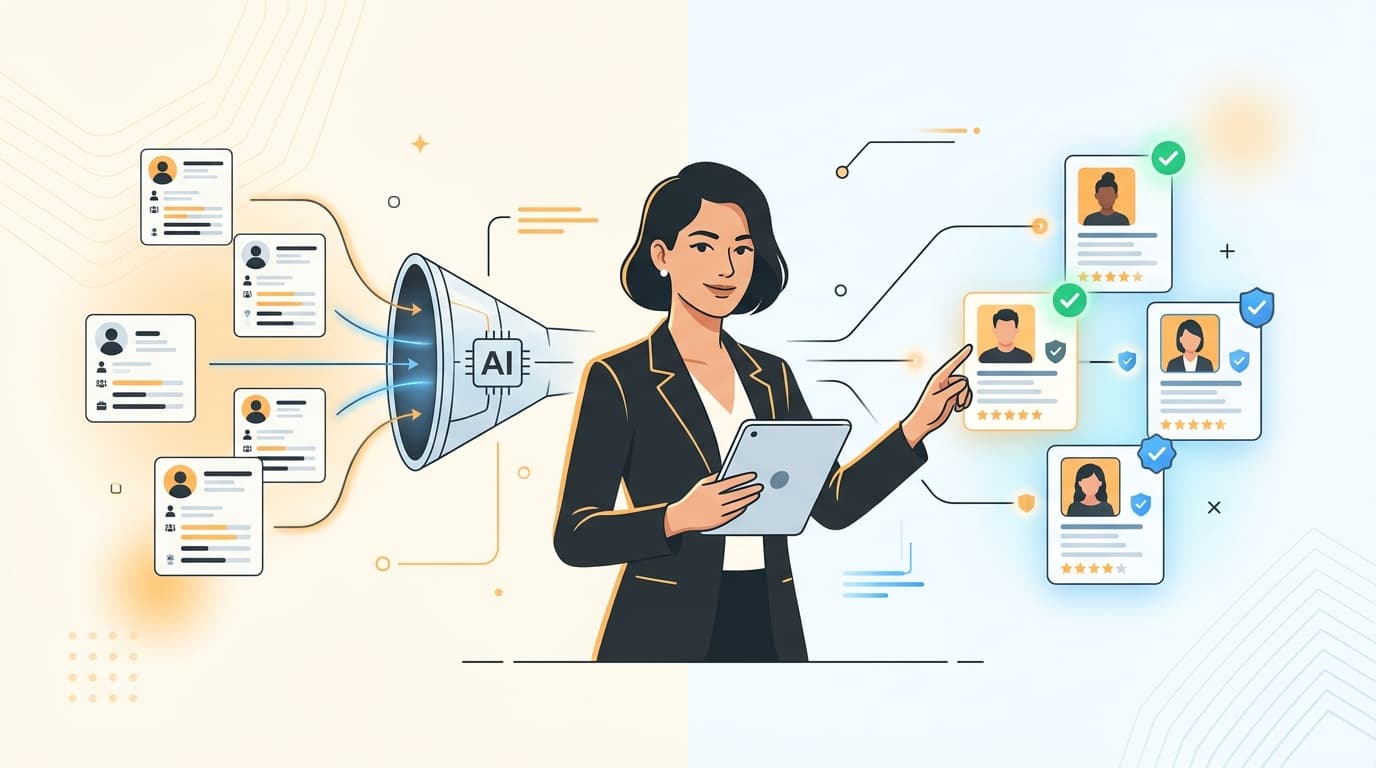
Traditional sourcing relies on Boolean searches, manual profile reviews, and copy paste outreach. That approach scales poorly and often misses passive or niche talent. AI agents candidate sourcing introduces autonomous or semi-autonomous agents that combine large language models, vector search, and business rules to execute sourcing tasks continuously. These agents can find hidden talent, customize outreach at scale, and feed your ATS with enriched, ranked candidates.
Core capabilities available in 2025
Below are the practical capabilities talent teams are using today. Each one is powered by the same architectural building blocks but wired for different outcomes.
1. Continuous talent discovery
AI agents candidate sourcing can monitor multiple sources simultaneously: public profiles, niche job boards, GitHub, research papers, conference attendee lists, and internal referral databases. Agents run scheduled crawls and keep a live pipeline, surfacing only candidates who match updated skill taxonomies and salary bands. That moves sourcing from episodic to continuous and reduces time to fill.
2. Semantic matching and skill mapping
Instead of exact keyword matches, AI agents candidate sourcing uses semantic embeddings to understand skills, project descriptions, and role context. Agents map job requirements to real candidate experiences even when titles differ. For example, a candidate with "data instrumentation" experience can be matched to a role requiring "observability engineering" because the agent understands the conceptual overlap.
3. Automated outreach with personalization at scale
Modern agents craft multistep outreach sequences that adapt to responses. They can draft personalized messages, pick the best contact channel, and schedule follow ups. These messages reference recent projects, public posts, or mutual connections to increase reply rates. When replies include questions, agents can generate contextual answers and flag complicated responses to a human recruiter.
4. Prequalification and interview scheduling
Simple screening questions and technical checks can be handled by agents. They parse responses, score candidates, and book interviews via calendar integrations. This removes administrative friction and ensures high intent candidates move forward quickly.
5. Enrichment and internal mobility matching
AI agents candidate sourcing enriches profiles with salary expectations, stack details, and relocation willingness by combining public data and candidate-provided inputs. They also compare active candidates against internal talent pools to identify rehiring or internal mobility opportunities.
Real examples and tools
Several vendor classes demonstrate these capabilities. Talent intelligence platforms like Eightfold.ai and HireEZ provide semantic search and profile enrichment. Outreach automation vendors integrate AI-driven message generation. Newer agent platforms layer workflow automation and LLMs to act autonomously on sourcing tasks. Practical implementations pair these tools with ATS integrations so candidate records stay consistent across systems.
Example: A mid-market staffing firm used an autonomous sourcing agent to fill 12 high-priority roles. The agent ran continuous searches, enriched profiles, and scheduled 90 candidate screens over four weeks, increasing interview-to-hire ratio by 18 percent while cutting time spent on sourcing by 40 percent.
Measurable benefits recruiters can expect
Adopting AI agents candidate sourcing yields measurable improvements when paired with clear metrics. Typical gains include faster pipeline generation, higher reply rates from personalized outreach, reduced time wasted on low-fit profiles, and improved quality of hire through better matching. These effects compound in high-volume staffing environments where agents work across dozens of roles concurrently.
Risks and operational controls
AI agents candidate sourcing is powerful but not without risk. Main issues include biased screening, privacy leaks, regulatory compliance, and candidate experience degradation if messages feel impersonal. You must implement guardrails:
- Bias audits: evaluate model outputs by demographic segments and adjust training data, filters, and scoring thresholds.
- Human-in-the-loop: require recruiter approval for hires or high-impact messages and maintain escalation paths.
- Data governance: log data access, secure PII, and comply with local privacy laws like GDPR or CCPA.
- Transparency and consent: be clear with candidates about automated screening and provide opt out options.
Integration and workflow design
Effective adoption of AI agents candidate sourcing depends on tight integration with your ATS, CRM, and calendar systems. Agents should create and update candidate records, track outreach status, and log candidate consent and communication history. Workflow design includes defining which tasks are fully automated, which require human approval, and which are only suggested to recruiters.
Operational playbook: five steps to get started
Follow this operational playbook to pilot agents without disrupting recruiting operations.
- Define success metrics: time to fill, interview to hire ratio, reply rate, and quality of hire.
- Choose a pilot: pick 3 to 5 roles with measurable demand and clear success criteria.
- Set guardrails: privacy, consent, approval gates, and anti-bias checks before sending outreach.
- Integrate with ATS: ensure candidate records sync and that scoring is visible to recruiters.
- Iterate on prompts and rules: refine agent behavior based on recruiter feedback and candidate responses.
Cost and ROI considerations
Licensing models vary: some vendors charge per seat, per role, or per candidate contact. The ROI calculation should include reduced recruiter hours spent on sourcing, faster fill times, and improved placement outcomes. For staffing firms that place high volumes, even small percentage gains in reply rates or time to fill translate to substantial margin improvements.
Candidate experience and brand preservation
Automation must preserve candidate experience. Use AI agents candidate sourcing to enhance personalization, not to replace human contact. Agents should reference public information accurately, respect communication frequency limits, and escalate conversations to humans at the first sign of interest. When done right, automation speeds up response times and creates a consistent, respectful experience.
Governance, ethics, and compliance
Establish governance practices for model updates, data retention, and audit trails. Maintain documentation for sourcing decisions and automated actions so you can demonstrate compliance during audits. Many organizations create multidisciplinary committees with legal, HR, and data science representation to approve agent behaviors and data use policies.
What to expect next
In 2025 and beyond, AI agents candidate sourcing will become more agentic, meaning agents will coordinate across multiple systems, learn from recruiter feedback, and negotiate scheduling autonomously. Expect tighter ecosystem integrations, improved skill ontologies, and better explainability features to inspect why a candidate was suggested. Recruiters who combine agent efficiency with human judgment will have a competitive advantage.
Insight: The most successful teams treat AI agents candidate sourcing as productivity amplifiers. They focus on designing workflows that let agents do repetitive, data-driven work while humans handle relationship building and final decision making.
Checklist for vendor selection
When evaluating solutions, use this checklist:
- Does the agent integrate bi-directionally with your ATS and CRM?
- Can you control and audit agent actions and prompts?
- Does the vendor provide bias testing and data governance tools?
- Is outreach personalization measurable and safe for brand voice?
- Does pricing align with your hiring velocity and contact volume?
Final implementation tips
Start with a focused use case, instrument outcomes, and treat models as living tools that need ongoing tuning. Train recruiters on how to read agent outputs, when to override, and how to maintain human touch. Use feedback loops so agents learn from the hires that succeed and from the candidates who decline.
Conclusion
AI agents candidate sourcing in 2025 is a pragmatic, production-ready set of capabilities that accelerates discovery, personalizes outreach, and streamlines screening when implemented with governance and clear metrics. The technology moves sourcing from reactive search to proactive pipeline building, but it requires careful integration, bias controls, and a commitment to candidate experience. Start small, measure impact, and scale agent responsibilities as trust grows. Combine agent scale with human judgment to win in a competitive talent market.