


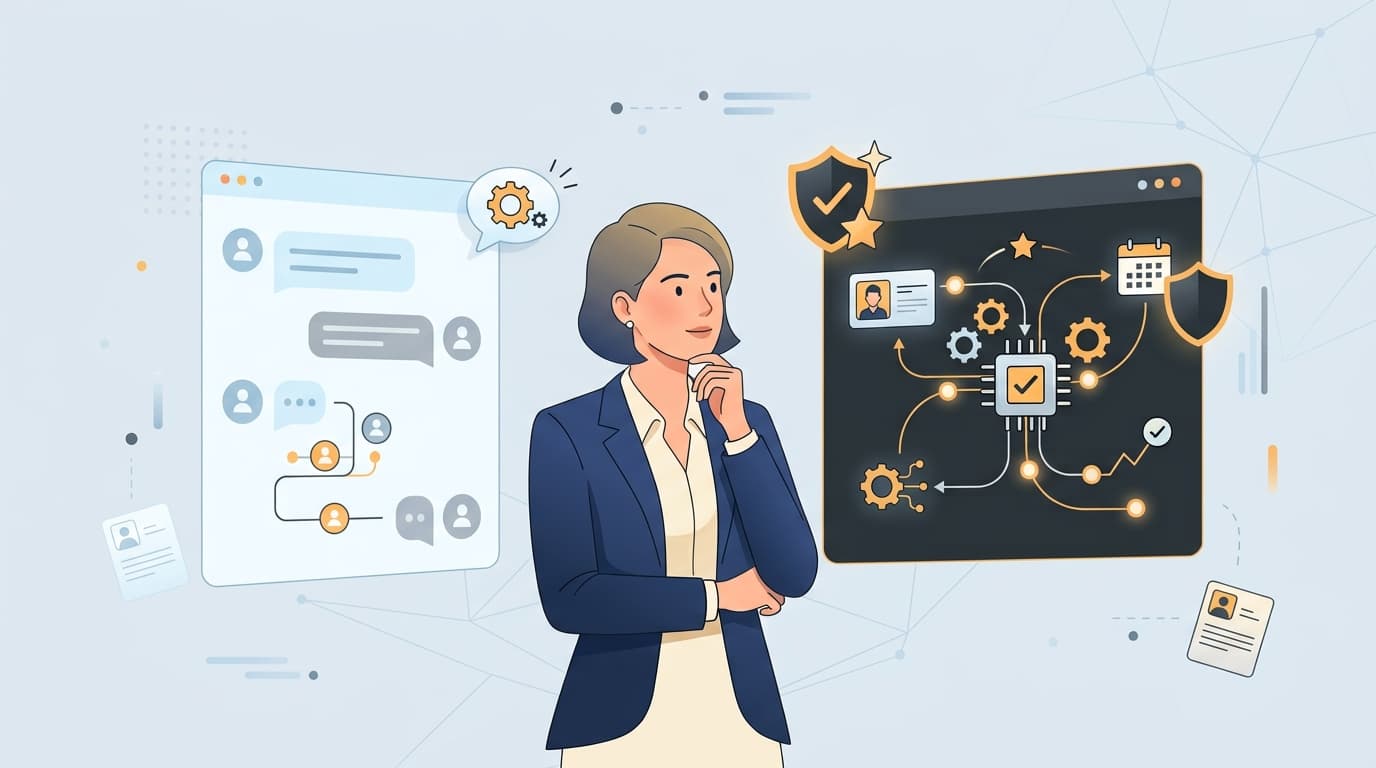
TL;DR
- AI agent vs AI chatbot recruitment is about autonomy and scope: agents act autonomously while chatbots converse.
- Use an AI chatbot for candidate engagement, scheduling, and FAQs at scale.
- Use an AI agent when you need multi-step autonomous workflows like sourcing, screening, and outreach.
- Integrate either with your ATS, CRM, and privacy controls to protect candidate data.
- Measure value by time-to-fill, quality of hire, candidate experience, and recruiter capacity.
- Start small with chatbots, pilot agents on limited roles, then scale based on metrics.
Introduction
Every recruitment firm exploring automation faces a clear question: should we deploy conversational tools or intelligent workflow machines? The debate centers on AI agent vs AI chatbot recruitment. Both technologies use artificial intelligence, but they serve different functions. Choosing the right option reduces recruiter workload, improves candidate experience, and protects employer brand. This long form guide breaks down the difference, shows real use cases, provides deployment checklists, and gives a practical roadmap for staffing and talent acquisition teams.
What is an AI chatbot?
An AI chatbot is a conversational interface designed to simulate human-like dialogue. Chatbots answer questions, run scripted or dynamic flows, and handle routine interactions at volume. In recruitment, chatbots typically manage tasks such as initial candidate outreach, FAQ handling, pre-screening questions, and interview scheduling. They excel at consistent, repeatable conversations and immediate responses on career pages, social channels, and SMS.
Key capabilities of chatbots
- Natural language understanding for basic screening questions.
- Form collection for resumes, contact data, and availability.
- Calendar integration to schedule interviews.
- Integration with ATS to create candidate records and update statuses.
What is an AI agent?
An AI agent is a more autonomous system built to execute multi-step tasks with decision-making ability. Agents can orchestrate sourcing, outreach, follow-up, candidate evaluation, and status updates without continuous human prompts. They can monitor multiple data sources, trigger actions in an ATS, and adapt sequences based on candidate responses and performance signals. Where chatbots converse, agents act across systems.
Key capabilities of agents
- Autonomous sourcing from job boards, LinkedIn, and proprietary databases.
- Multi-step outreach sequences that adjust based on replies.
- Resume parsing, ranking, and shortlisting based on configurable criteria.
- Automated interview coordination across multiple stakeholders and systems.
- Execution of conditional workflows including escalation to recruiters.
AI agent vs AI chatbot recruitment: core differences
Understanding the practical differences helps you match technology to use case. Here are the core contrasts between AI agent vs AI chatbot recruitment:
- Scope: Chatbots handle conversations. Agents manage end-to-end tasks across systems.
- Autonomy: Chatbots need user prompts during interactions. Agents run predefined campaigns and take actions without constant human input.
- Complexity: Chatbots are often simpler to deploy. Agents require integration, rules, and governance design.
- Use cases: Chatbots are ideal for candidate engagement and FAQs. Agents are best for sourcing, screening, and process automation.
Example scenarios
Scenario 1: A recruiter wants faster interview scheduling. A chatbot on the careers page asks availability and books interviews via calendar integration. Scenario 2: A high-volume enterprise role needs continuous sourcing. An AI agent runs nightly searches, sequences outreach, evaluates replies, and surfaces top candidates for recruiter review. Both improve efficiency, but the agent replaces many manual steps.
When to pick a chatbot
Choose a chatbot if your primary needs are high-volume candidate engagement and immediate response. Chatbots are lower risk, quicker to implement, and provide immediate candidate experience gains. Use chatbots to:
- Answer common candidate questions about benefits, salary, or remote policies.
- Screen basic qualification questions and collect resumes.
- Confirm interview times and handle rescheduling.
- Conduct pulse checks after onboarding steps.
When to pick an agent
Choose an agent when you want automation that spans sourcing, evaluation, and outreach. Agents are appropriate if you need to scale repetitive recruiting activities and free skilled recruiters for high value work. Use agents to:
- Continuously source passive talent and remove unqualified matches with intelligent filters.
- Personalize multi-touch outreach at scale while learning what messages perform best.
- Execute screening workflows including skill matching using embedded models.
- Integrate decisions into ATS workflows and trigger human handoffs based on confidence thresholds.
Practical considerations before buying
Whether you choose an AI agent or AI chatbot, consider these governance and integration items up front. They will determine the speed of value and the risk profile.
- Privacy and compliance: Ensure data handling follows GDPR, CCPA, and local rules for candidate data.
- ATS and CRM integration: Confirm bi-directional syncing of candidate records, notes, and statuses.
- Security and audit trails: Agents acting autonomously need logs and easy rollback.
- Explainability: For screening decisions, preserve human-readable rationales to reduce bias risk.
- Human-in-the-loop controls: Build clear escalation points and override capabilities for recruiters.
Budget and team readiness
Chatbots often appear in monthly subscription pricing and require less technical setup. Agents may require professional services, API access, and engineering support. Staff readiness matters. If recruiters are not trained on automation workflows, start with chatbots to build trust, then adopt agents for more complex automation.
Measuring ROI
Create metrics to prove value. Compare before and after performance for the same roles and cycles. Key metrics include:
- Time-to-fill reduction.
- Number of qualified candidates per role.
- Recruiter time saved per week.
- Candidate satisfaction and completion rates.
- Interview-to-offer and offer-acceptance ratios.
In practice, firms that deploy a chatbot for scheduling often see immediate time savings of 10 to 30 percent in administrative tasks. Firms that pilot agents for continuous sourcing sometimes cut sourcing time by 30 percent or more for hard to fill roles. Industry surveys in recent years show that more than half of talent teams using AI report measurable productivity gains within three months of deployment.
Real world examples and insights
Example 1: A mid-size staffing firm struggled to engage early-stage applicants. They implemented a chatbot on job postings to confirm qualifications and filter out unqualified candidates. The result: a 40 percent drop in no-shows for phone screens and better candidate data in the ATS.
Example 2: A national talent agency implemented an AI agent for sourcing niche engineering talent. The agent ran scheduled searches, sequenced personalized outreach, and recommended candidates to recruiters using a confidence score. Recruiters accepted 70 percent of agent-sourced candidates for interviews, and time-to-fill improved on critical roles.
Tip: Start with clear success criteria. A pilot that defines the target metric, timeframe, and escalation rules minimizes disappointment and speeds scaling.
Implementation roadmap
Follow these steps whether you choose an AI agent or an AI chatbot for your recruitment firm.
- Define objectives and KPIs aligned to business goals.
- Map workflows and identify integration points with ATS and calendar systems.
- Select a vendor and run a proof of concept on a small set of roles.
- Train the model or configure the dialog flows using real historical data where possible.
- Monitor performance, collect recruiter feedback, and iterate rapidly.
- Scale gradually, adding governance and reporting as automation increases.
Pilot checklist
- Simple hypothesis: e.g., reduce scheduling time by X percent.
- Data access: ensure the pilot has sample candidate and job data.
- Integration points: calendar, ATS, and messaging channels connected.
- Metrics dashboard: real-time view of candidate flow and conversions.
- Fallback plan: human takeover if the automation fails or confidence is low.
Common pitfalls to avoid
- Deploying an agent without clear guardrails or human oversight.
- Over-automating high touch candidate experiences where personal contact matters.
- Failing to integrate with the ATS, which creates data silos and manual rework.
- Ignoring diversity and fairness during model configuration and testing.
Decision guide: chatbot, agent, or hybrid?
Match the technology to your immediate needs, risk tolerance, and long term roadmap. Use this guide:
- If you need fast wins in candidate engagement and scheduling, choose a chatbot.
- If you need to automate sourcing and multi-step workflows, choose an agent.
- If you want both, adopt a hybrid approach: chatbots for front-end engagement and agents for backend orchestration and sourcing.
Conclusion
AI agent vs AI chatbot recruitment is not an either-or proposition. Chatbots excel at conversational tasks and rapid candidate engagement. Agents deliver autonomous, multi-step process automation that can transform sourcing and screening. For most recruitment firms the pragmatic path is to start with chatbots to build confidence and candidate experience wins, then pilot agents on specific high-volume or high-complexity roles. Measure everything, keep humans in the loop, and make governance a priority. With the right approach, AI agent vs AI chatbot recruitment technologies amplify recruiter skills, speed hiring, and improve candidate outcomes.